The North Australia Metocean Study (NAMOS) is a Joint
Industry Project (JIP) that responds to the need for
an assessment of the extreme wind and wave climate
offshore North and Northwest Australia, which is largely
associated with tropical cyclones. Described in further
detail below, the original NAMOS JIPs are named NAMOS
(Phase 1 and 2), NAMOS-II, NAMOS-Comp, and GFNA
(GROW-Fine_NW_Australia). The newest iteration of the
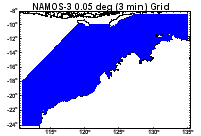
NAMOS JIP family is NAMOS-3. Completed in early 2024,
NAMOS-3 (Phase 1) features a complete overhaul of the
basin including using a finer grid (0.05 deg, ~5.5 km),
finer archive time step of 10 minutes, ERA-5 boundary
spectra and background winds, and the BOM reanalysis
of tropical cyclones completed in 2018. The nominal
storm population contains 191 tropical cyclones for the
period 1981-2022. Phase 2 is underway and will add
track-shifted versions of the nominal storm tracks.
Spectra are archived at 1035 points at a 10-minute
time step.
Dating
back to 2010, the original NAMOS
JIP consisted of 77 top-ranked tropical cyclones from
the northwest shelf subregions of Carnavon Basin and
Timor Sea/Browse Basin. To expand the population of
storms, track-shifting was imposed on all of the storms
with an average of 9.45 shifts per storm. Later, Phase
2 increased the number of nominal storms to 124 and
the number of shifts to an average of 14.66 shifts
per storm. The final update was completed in
late 2014 and addressed 160 tropical systems from
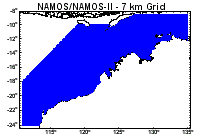
the period 1970-2013. NAMOS was archived every 15 minutes
on a 7-km grid with Spectra archived at 777 locations.
NAMOS-II
was a secondary JIP that concentrated on extra-tropical
cyclones primarily from 3 regimes: easterly trade
wind intensifications, westerly trade wind enhancements,
and long period swell imported from intense extra-tropical
cyclones that migrate across the Southern Indian Ocean.
Nearly 200 events were chosen for this hindcast between
1979 and 2013 and archived 1-hourly on the same original NAMOS
grid. Spectra were available at 784 locations.
Participants
who joined both the original NAMOS
and NAMOS-II JIPs were eligible to join NAMOS-Comp.
The NAMOS-Comp JIP combined both storm populations into
a long-term, comprehensive, uniform operational hindcast
for the period 1979-2013 and was archived 1-hourly.
Spectra were available at 796 locations.
GROW-Fine_NW_Australia
(GFNA) addressed the need for day-to-day continuous
operations and became the only portion of the NAMOS project
that was available for purchase by the grid point for
non-JIP participants and in bulk for
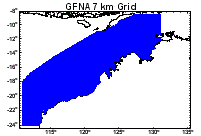
JIP participants. GFNA used the same 7-km grid
system as original NAMOS, but the final archive ended east of 131E. The
hindcast was archived 1-hourly from 1999-2009.